Tyson and Billy Architects
20Jan/120

Fort Madison, Iowa

Our team is currently road tripping to Iowa dodging snowstorms and icy roads to check in on our projects. Although field reports in early January are far from glamorous, our mild winter has been a boon for construction and not all together dismal for field visits.

That being said, I sit at my desk and the guys bring me back pictures to create our blog posts with. I'm not the one with frozen toes on a mission to bring back pictures to quell my demands for blog content.

Thaddeus was kind enough to gear up and visit Fort Madison's historic sites and bring back wonderful pictures.

A very brief history on Fort Madison:

Fort Madison was established as a military post along the Mississippi River built in 1808 and survived until intentional destruction in 1813. It was named for President James Madison and occupied during the war of 1812.

Originally built by the U.S. Army to control the recently acquired Louisiana Purchase territories and trade with the Native Americans in the Upper Mississippi River region. It is known as the site of Blackhawk’s first battle with U.S. Troops.

As of 1804 the U.S. had control over western Illinois and parts of what is now Iowa due to a disputed 1804 treaty with the Sauk and affiliated tribes. The U.S. Army saw the need to post a fort along the Mississippi and monitor the major trading route into the interior of Iowa.


Wikipedia ~ Artists rendering of Fort Madison

The original Fort was poorly placed as it was constructed next to a deep ravine and the base of a bluff providing a safe location for forces opposing the Fort to reign destruction upon them from above.

Black Hawk lamented over the new fort, and disparaged its construction in his autobiography:

On our arrival we found that they were building a fort. The soldiers were busily engaged in cutting timber, and I observed that they took their arms with them when they went to the woods. The whole party acted as they would do in an enemy's country. The chiefs held a council with the officers, or head men of the party, which I did not attend, but understood from them that the war chief had said that they were building homes for a trader who was coming there to live, and would sell us goods very cheap, and that the soldiers were to remain to keep him company. We were pleased at this information ad hoped that it was all true, but we were not so credulous as to believe that all these buildings were intended merely for the accommodation of a trader. Being distrustful of their intentions, we were anxious for them to leave off building and go back down the river.

—Black Hawk, Autobiography (1882)

Given the deception evident in Black Hawk's account, almost from the beginning the Fort was attacked by the Sauk.

Efforts to increase the Fort's defenses proved futile to the geographical advantage of those attacking it.

The War of 1812 fueled the British-allied Sauk and other tribes to began a determined effort to push out the Americans and reclaim control of the upper Mississippi.

Beginning in July 1813, attacks on troops outside the Fort led to a siege with conditions so dangerous that the bodies of soldiers killed outside the Fort could not be recovered, and troops could not leave the Fort. Outbuildings were intentionally burned by the Army to prevent them from falling into Indian hands.

It is believed that in September of 1813 after weeks of this paralyzing siege, the Army finally abandoned the post, burning it as they evacuated.

Black Hawk observed the ruins soon after. “We started in canoes, and descended the Mississippi, until we arrived near the place where Fort Madison had stood. It had been abandoned and burned by the whites, and nothing remained but the chimneys. We were pleased to see that the white people had retired from the country.”

—Black Hawk, Autobiography (1882)

What can be visited today as the Historical Fort Madison was constructed in 1983 on the historical "site", but wisely relocated farther away from the bluff and ravine.

Fort Madison is charmingly centered between the Mississippi River and their historic downtown.

Within sightline of the Fort is the Fort Madison Toll Bridge. The last remaining and world's largest double swing-span bridge on the Mississippi River containing a top level for cars and a bottom level for trains.

(Pictured below, background right. )

70+ trains per day to cross the Mississippi, as well as opening over 2000 times per year to allow barges to move goods and materials across the world.

Long after the Fort Madison of 1808 the city of Fort Madison was settled in 1838 as a river town trading post. The town eventually became reliant upon the railroads and manufacturing.

Pictured above the Steam Locomotive 2913: this 708,000 lb. engine, built in 1944, had been used to haul war equipment in the western states. Engine 2913 was retired October 1955.

The Atchison, Topeka and Santa Fe Railway (reporting mark ATSF), often abbreviated as Santa Fe, was one of the larger railroads in the United States.

Over 100 freight trains a day still pass through Fort Madison.

Engine #2913 is the A.T. & S.F. Steam Engine 2913 given to the city by the Sante Fe in 1959. Dedicated in 1960 during the 72nd anniversary of the Sante Fe’s first through train to Chicago and Kansas City.

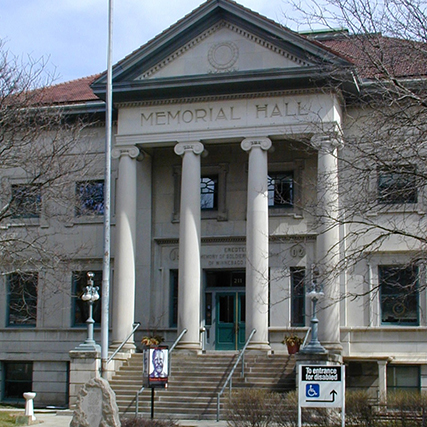
Other Fort Madison attractions include the Sheaffer Pen Museum, Daniel McConn Barn, Memorial for Veterans of the Civil War, Topeka and Sante Fe Railroad Depot, the Albright “Betsy Ross” House, and the Sante Fe Bridge.

I hope your travels will take you through Fort Madison to this charming city with their rich history.

~ Kelly

Pictures By: Thaddeus

Edited By: Yours Truly

Sources for Information:

Wikipedia: Fort Madison, Iowa

Wikipedia: Toll Bridge

Wikipedia: Atchison, Topeka and Santa Fe Railway

The Great American Stations

Fort Madison: City Homepage


Comments (0) Trackbacks (0)

No comments yet.


Leave a comment

(required)

No trackbacks yet.